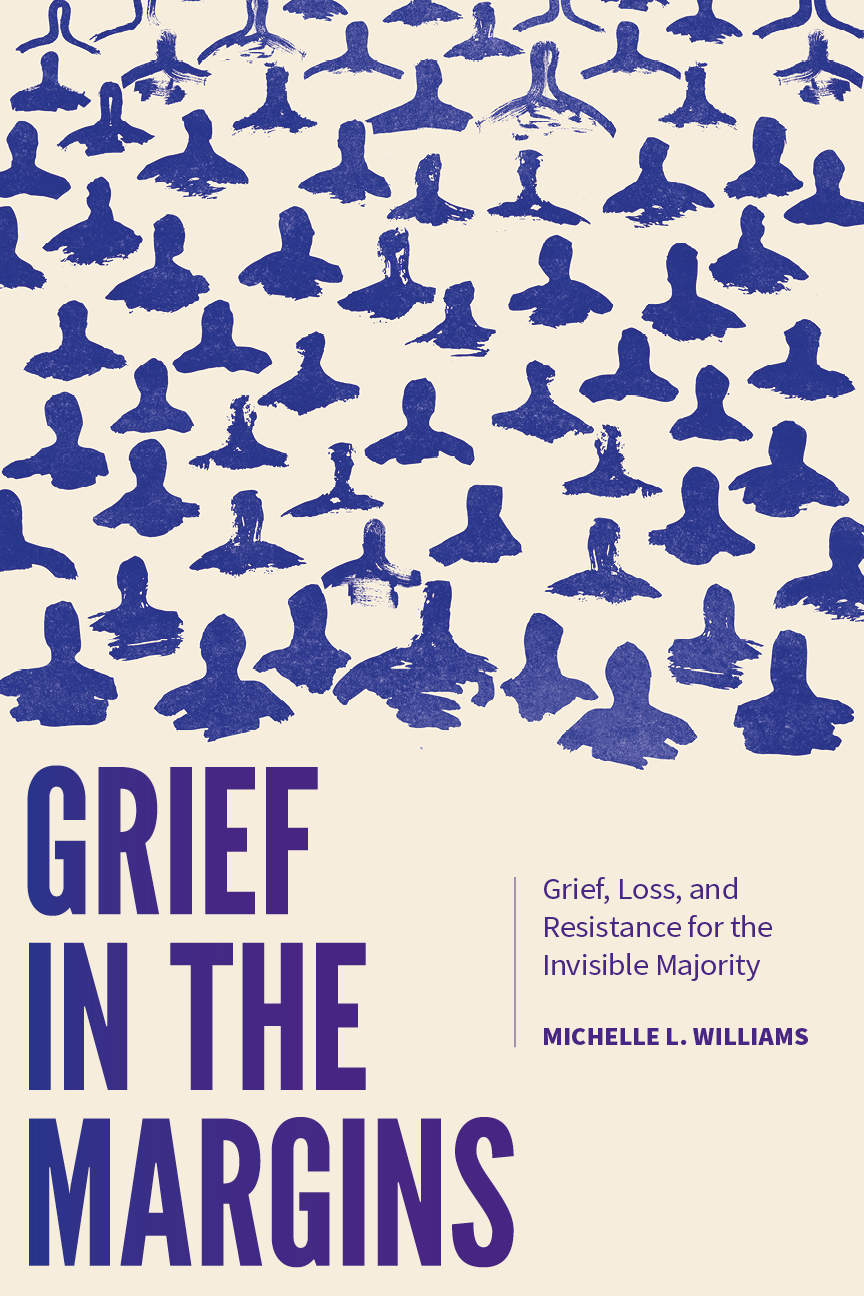
Grief in the Margins explores the ways in which grief manifests in the “Invisible Majority” (racialized and underrepresented groups) and how the intersections of identity shape how this community experiences loss. Through examining the cultural implications of grief and loss, this text takes a closer look at the phenomenon of collective grief and considers the effect of dominant Western culture on the ability of an individual or a community to grieve effectively.
The author provides a social commentary on the systems and structures, such as white supremacy and anti-Black racism, that make loss and grief more prevalent in racialized and underrepresented communities. The topics discussed include an exploration of the BLM movement as a manifestation of grief and as a response to long-standing historic and continued loss due to anti-Black racism, police brutality, slavery, and colonialism, as well as the history of residential schools in Indigenous communities, resulting in systematic losses including the dismantling of Indigenous families, culture, and traditions.
Readers will gain insight and understanding of a universal human experience that is systematically and structurally inequitable. Grief in the Margins is an essential text for college and university courses focusing on grief and loss, bereavement, and death and dying.
FEATURES
Written by a woman of colour, this text provides insight into the experience of loss for BIPOC, 2SLGBTQIA+, chronically ill, and disabled communities
Challenges the conventional understanding of grief to explore a variety of experiences of loss beyond death, and takes a closer look at the phenomenon of collective grief
Robust pedagogical features, including a case study, questions for critical thought, text boxes, and references
Introduction: The Invisible Majority, Language, and Limitations
Chapter 1: On Grief and Loss
Chapter 2: Grief, Health, and Racial Trauma: The Intersection of Personal and Collective Loss
Chapter 3: Grief and Oppression
Chapter 4: Collective Grief
Chapter 5: Disenfranchised Grief
Chapter 6: Grief and White Supremacy
Chapter 7: Grief, Loss, and Social Justice Movements
Chapter 8: Grief, Mourning, and Cultural Appropriation
Conclusion: Supporting the Invisible Majority in Grief Through Decolonization, Social Justice, and Cultural Responsiveness
Biography
Michelle Williams is a skilled and knowledgeable mental health professional, DEI advocate, and entrepreneur with an interest in promoting emotional well-being and social equity. She is the co-founder and co-CEO of Therasource Inc. (www.therasource.ca), a digital mental wellness platform offering expert-curated therapy resources—including educational videos, online workshops, and immersive exercises—to support self-guided mental health care, whether as an introduction to therapy or a supplement to ongoing treatment.
Michelle holds a degree in psychology and a Master of Social Work from the University of Waterloo, and has extensive clinical experience, providing individual, relationship, and family therapy through private practice. Her work has been featured in media outlets such as CTV’s The Social, The Huffington Post, and a variety of podcasts.
Michelle combines clinical insight with innovative leadership to create accessible, transformative mental health solutions.
“An insightful and nuanced read that brings to life the concepts of grief co-mingled with the complexities of racism and other forms of marginalization. The brilliance of this text is seen both in its contents and construction, making it an easy and thought-provoking read that engages its readers through the use of provocative and critical questioning.”
—Kathy Hogarth, PhD, Associate Vice President, Global Strategy, Wilfrid Laurier University
“Michelle L. Williams makes visible our individual and collective experiences with grief, trauma, and belonging. Her groundbreaking book Grief in the Margins provides a deep analysis of Western transactional culture grounded in capitalism and colonialism that has erased, suppressed, and oppressed the lives of Black, Indigenous, and racialized people. As a human rights activist, mixed racial woman, and immigrant, I found hope in her compelling arguments for culturally responsive practices and embedding social justice in grief counselling as pathways towards justice.”
—Shanaaz Gokool, Executive Director at Leadnow.ca
“In Grief in the Margins, Michelle Williams has written a book that is both a powerful critique of the social inequalities in who gets room for grief and mourning, and also a profound framework for understanding systems of marginalization and oppression in terms of the loss and grief they cause. This is the book to read if you want to show up fully for friends, clients, or patients whose experience of grief may be quite different from your own.”
—Alexandra Samuel, technology researcher, journalist, and co-author of Remote, Inc.: How to Thrive at Work…Wherever You Are
“I am so deeply grateful that this book exists. Michelle L. Williams has created a resource that centralizes so many important topics that continue to need to be lifted up in the grief and end-of-life field. I cannot wait to share it with colleagues, peers, clients, and partners—because after the publishing of this work, there is no excuse for folks to ignore the realities of how who we are impacts how we grieve. Thank you, Michelle, for writing, researching, and publishing something that delves deeply into the darkness of our systems and myths about the universality of grief experiences—to ultimately create something that’ll bring light and visibility into the lives of the communities we all serve. I hope and believe that the field having access to this will result in better outcomes and care for folks in the ‘invisible majority’.”
—Alica Forneret (she/her), consultant, educator, and author dedicated to creating new spaces for people to explore personal grief and collective grieving
Instructor Resources
Instructors adopting Grief in the Margins for their course will receive access to an Instructor Resource Guide.
Contact your rep to view a supplement sample or request a download code.
Reflowable eTextbooks respond to the size of the device they are viewed on, much like a typical website. This causes them to look different from a traditional book. They may also contain embedded audio, video, or interactive components in addition to the VitalSource Reader's standard study tools.
What is a Fixed Layout eBook?
A fixed layout eTextbook maintains the look and the feel of a printed textbook. The text is fixed, and the screen size determines the size of the text. These eTextbooks work best on large-screen devices and do not contain any embedded media or interactive content.
Auto Renew
Auto renew allows e-book rentals to be automatically renewed after the initial rental duration. If enabled, you will automatically be charged and your rental will renew for the same duration as purchased. Auto renew is set to off by default. If auto renew is off, you lose access to the e-book after the rental duration.
Hi there!
All digital products are non-refundable and cannot be downloaded outside of the VitalSource Bookshelf app.
The digital eBook you have selected is a Rental and will expire when the selected duration runs out. If you would like to purchase lifetime access to this eBook, please select a Purchase option instead.