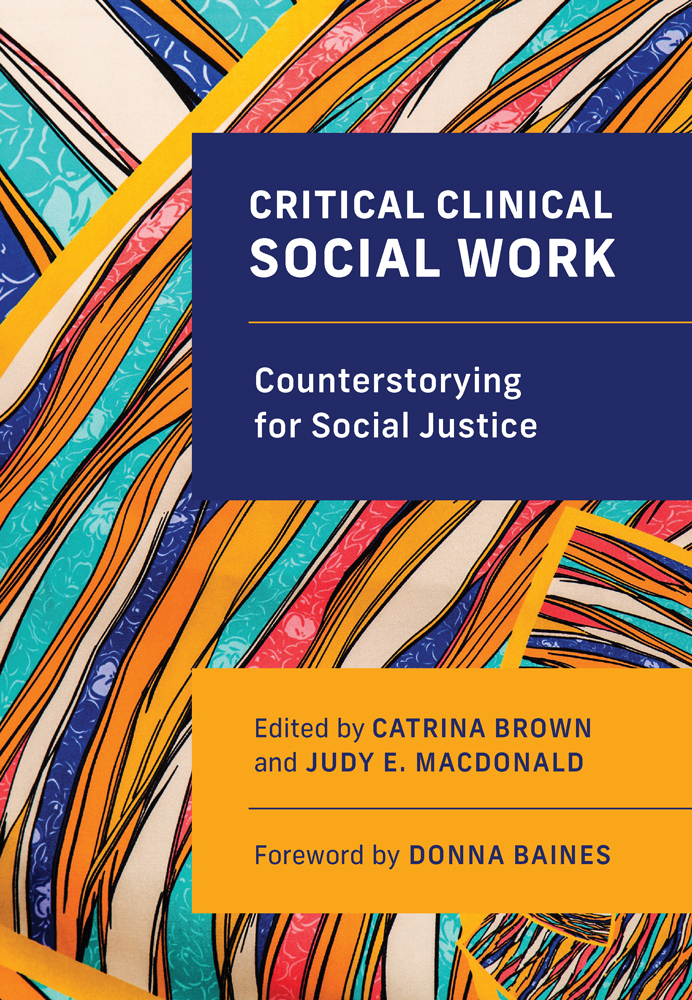
With the aim of producing counterstories that participate in social resistance, Critical Clinical Social Work focuses on integrating critical theory with direct clinical practice. Exploring the impact of oppression and power in constraining and limiting people’s voices, this timely resource moves social work forward by highlighting the practical application of feminist, narrative, anti-racist, and postcolonial frameworks. The contributors tackle a range of substantive issues including ethics, working with complex trauma, men’s use of violence, substance use among women and girls, Indigenous social work praxis, critical child welfare approaches, counterstorying experiences of (dis)Ability, and animal-informed social work practice.
Written by Canadian social work educators and filled with illustrative case studies, this text offers a Canadian perspective on the diverse issues social workers encounter in the field. This edited collection is an indispensable resource for social work practice and theory courses, and a must-read for professional practitioners.
FEATURES
promotes critical clinical skills consistent with anti-oppressive and social justice paradigms of social work
offers case histories and examples of direct critical clinical practice
concludes with reflections on social resistance and transformation through counterstorying
Introduction: Critical Clinical Social Work: Counterstorying for Social Justicem, by Catrina Brown and Judy E. MacDonald
Chapter 1: Critical Clinical Social Work: Theoretical and Practical Considerations, by Catrina Brown
Chapter 2: Critical Clinical Ethics, by Merlinda Weinberg
Part II: Critical Clinical Practice: Mental Health, Trauma, and Social Justice
Chapter 3: Feminist Narrative Therapy and Complex Trauma: Critical Clinical Work with Women Diagnosed as “Borderline”, by Catrina Brown
Chapter 4: Critical Clinical Approaches with Girls and Their Experiences of Sexualized Violence, by Marion Brown
Chapter 5: Exploring Trauma and Masculinity among Men Who Perpetrate Intimate Partner Violence, by Tod Augusta-Scott
Chapter 6: Strategies for Critical Clinical Practice in Veterans’ Mental Health, by Catherine Bryan and Tessa Barrett
Chapter 7: Safety, Belonging, and Voice: Critical Clinical Practice with Girls and Women Struggling with Substance Use, by Nancy Ross< and Jean Morrison
Chapter 8: Animal-Informed Social Work: A More-Than-Critical Practice, by Cassandra Hanrahan and Darlene Chalmers
Part III: Critical Social Welfare and Institutional Practices
Chapter 9: The Whole or Part? Postcolonial Theory versus Clinical Approaches to Marginalized Groups’ Quest for Social Services, by Ifeyinwa Mbakogu
Chapter 10: Critical Intercultural Communication and Practice: Applying Knowledge and Skills to Prevent Entry or Re-entry of Children and Youth into State Care, by Sara Torres, Monique Nutter, Donna Mae Ford, Yvonne Chiu<, and Kathi Campbell
Chapter 11: Epistemic (In)Justice in Child Welfare Risk Assessment, by Marjorie Johnstone
Chapter 12: AIDS Quarantine Revisited in British Columbia’s Treatment as Prevention: Possibilities for Critical Clinical Social Work in the Era of HIV Criminalization, by Eli Manning and MT O’Shaughnessy
Part IV: Working in the Context of Marginalization, Oppression, and Diversity
Chapter 13: Spirituality as a Resource for Well-Being in African Canadian Communities, by Wanda Thomas Bernard, Josephine Etowa, and Barbara Clow
Chapter 14: (De)Colonizing Indigenous Social Work Praxis within the Borderlands, by Gail Baikie
Chapter 15: Counterbalancing Life with Chronic Pain through Storying Women’s Experiences of (Dis)Ability, by Judy E. MacDonald
Chapter 16: Validating Voice in Critical Clinical Work with Older People, by Joan R. Harbison and Donna Pettipas
Part V: Conclusion
Chapter 17: Doing Critical Clinical Work from the Ground Up: Exploring the Dalhousie School of Social Work Community Clinic, by Jeff Karabanow, Sarah Oulton, Meagen Bowers, and Cyndi Hall
Conclusion: Practices of Resistance through Counterstorying for Social Justice, by Catrina Brown and Judy E. MacDonald
Contributor Biographies
Biography
Catrina Brown is an Associate Professor and Graduate Coordinator in the School of Social Work at Dalhousie University, with cross-appointments in Gender and Women’s Studies and Nursing. Her anti-oppressive work centres on women’s health and mental health, substance use, feminist narrative research, and integrating critical theory into direct practice.
Judy E. MacDonald is the Director of the School of Social Work and Assistant Dean of Equity and Inclusion in the Faculty of Health at Dalhousie University. Her work focuses on access and inclusion within post-secondary institutions for students with (dis)Abilities, autoethnographic and narrative storying of (dis)Ability, and anti-oppressive ways of working across abilities.
“Finally, a clinical social work text that respectfully engages with existing critical social work literature! This work is a courageous and necessary engagement with the complexities of applying critical theories and post-, anti-, neo-, and de- (modern, liberal, structural, colonial) epistemologies to clinical social work. An absolute necessity for critical social work practice.”
— Ameil J. Joseph, PhD, Associate Professor, School of Social Work, McMaster University
“Definitely a game-changer. This edited collection offers a critical praxis that bridges the gap between clinical social work and social justice oriented approaches to social work practice. The contents are broadly discussed and useful to readers across Canada and the globe. A must-have book for every social work educator and practitioner.”
—Paul Banahene Adjei, PhD, Associate Professor, School of Social Work, Memorial University of Newfoundland
Instructor Resources
Instructors who adopt Critical Clinical Social Work for their course will receive access to supplementary materials, including PowerPoint chapter slides and a test bank.
Contact your rep to view a supplement sample or request a download code.
eBooks cannot be downloaded to your device/desktop outside of the RedShelf e-Reader App, and cannot be printed in full.
All purchases of digital products are non-refundable.
To learn more about our digital products please view our Customer Support page.
What is a Reflowable ebook?
Reflowable eTextbooks respond to the size of the device they are viewed on, much like a typical website. This causes them to look different from a traditional book. They may also contain embedded audio, video, or interactive components in addition to the RedShelf Reader’s standard study tools.
What is a Fixed Layout eBook?
A fixed layout eTextbook maintains the look and the feel of a printed textbook. The text is fixed, and the screen size determines the size of the text. These eTextbooks work best on large-screen devices and do not contain any embedded media or interactive content.
Auto Renew
Auto renew allows e-book rentals to be automatically renewed after the initial rental duration.
If enabled, you will automatically be charged and your rental will renew for the same duration as purchased. Auto renew is set to off by default. If auto renew is off, you lose access to the e-book after the rental duration.
Hi there!
The digital eBook you have selected is a Rental and may expire when the selected duration runs out. If you would like to purchase lifetime access to this eBook, please select a Purchase option instead.
eBooks cannot be downloaded to your device/desktop outside of the RedShelf e-Reader App, and cannot be printed in full.
All purchases of digital products are non-refundable.
To learn more about our digital products please view our Customer Support page.