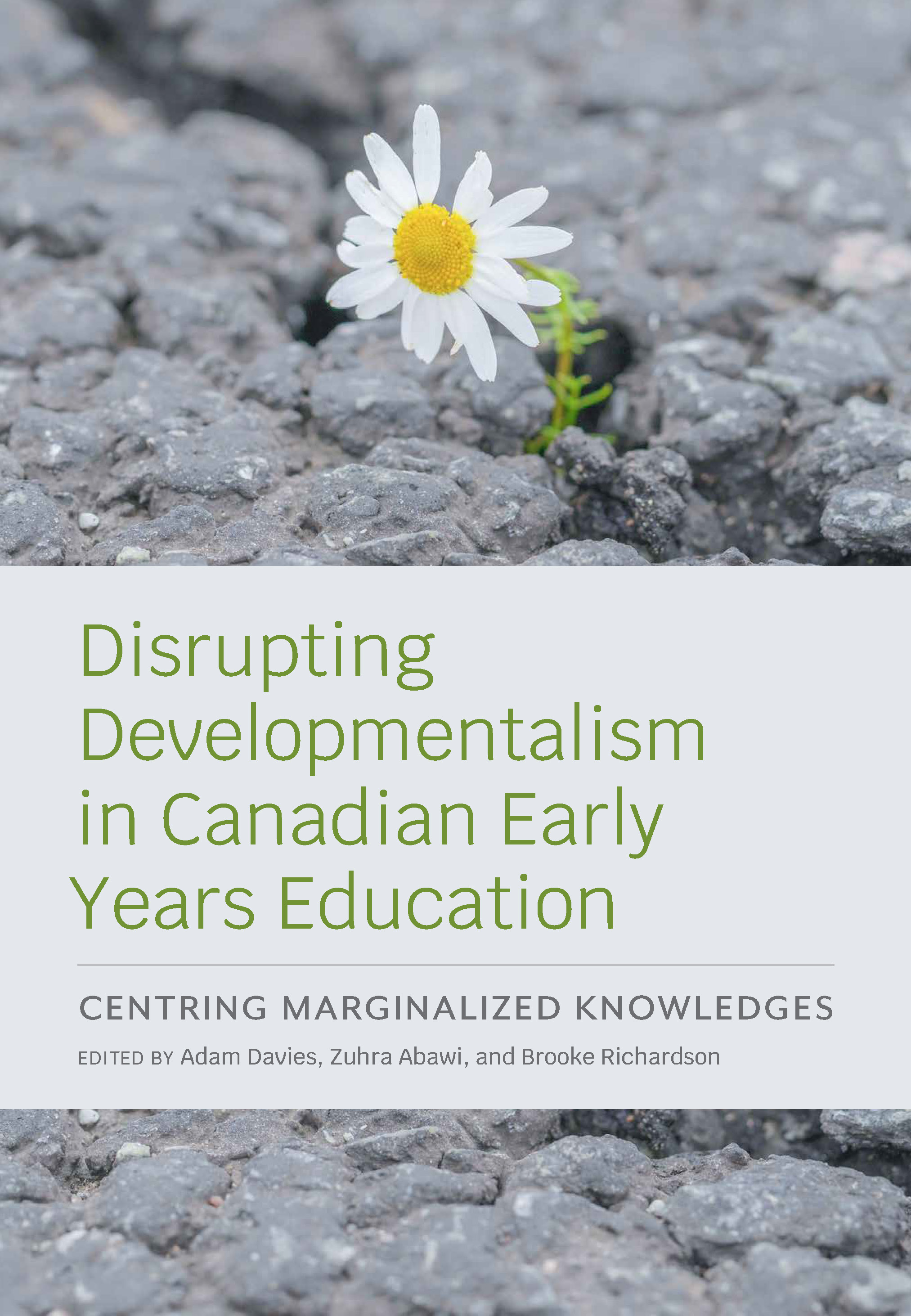
Disrupting Developmentalism in Canadian Early Years Education challenges dominant discourses about children and childhood by centring marginalized and subjugated voices, experiences, and knowledges. Confronting systemic white supremacy, cis-heteronormativity, ableism, and sanism rooted in developmental psychology, the authors invite educators to imagine new possibilities for understanding children, childhood, and education. The collection explores critical activist knowledges for disrupting developmentalism through contributions from teachers, practitioners, and educators, including narratives and lived experiences. This text will be an invaluable resource for early childhood education, teacher education, and child and youth studies programs in Canadian colleges and universities with courses focusing on child development, equity, diversity, inclusion, critical perspectives, and/or contemporary issues in early childhood education.
Features
Critiques of the dominance of developmental psychology, specifically developmentalism, that reigns in post-secondary early years and elementary teacher education programs
Diverse perspectives from educators, practitioners, community advocates, and activists from across the country
Robust pedagogical features including chapter overviews, end-of-chapter glossaries of key terms, and critical thinking questions
Introduction: Disrupting Developmentalism to Create Space for New Knowings and Becomings in Early Childhood Education
Adam Davies, Brooke Richardson, and Zuhra Abawi
Chapter 1: Struggling with the Work of the Pedagogist in Canada: Subtracting Early Childhood Education from Child Development
Nicole Land, Cristina Delgado Vintimilla, and Veronica Pacini-Ketchabaw
Chapter 2: In the Threshold of a Cruel and Humble Optimism—Contesting Developmentalism Through Critical Disability Studies
Maria Karmiris
Chapter 3: (Re)Imagining Human Development: Opening Decolonizing Possibilities Through a Post-Secondary Educational Psychology Course
Nikki Yee
Chapter 4: “Every Child Matters”: Canadian Pre-Service Teachers’ Critical Engagement with Indigenous Life-Narrative Picture books
Eunju Choe
Chapter 5: Honouring the Learning Spirit of Indigenous Children in Early Education
Sharla Mskokii Peltier and Lois Maplethorpe
Chapter 6: Decolonizing a Linear Conception of Teacher Education: Disrupting Developmental Paradigms Through an Ethics of Care
Petra Mikulan
Chapter 7: Re-Storying of an Immigrant Child in Canada: Exploring Pedagogical Criticalities in Problematizing the Dominant Clinical Discourses
Koichi Haseyama
Chapter 8: Disrupting Developmentalism Through Queer Theory in Post-Secondary Early Childhood Education: A Document Analysis
Dane Di Cesare, Jaime Barratt, and Adam Davies
Chapter 9: “So That’s When I Started to Feel the Passion in My Heart Start to Evolve”: Being Cared About and Caring for Pedagogy Through a Feminist Care Ethics
Rea Knight
Chapter 10: Objections to Objective List Theories and Development as Well-Being
Heather Krepski
Chapter 11: Decolonizing our Understanding of Indigenous Children and Learning
Jeffrey Wood
Chapter 12: Is Psychoanalysis Developmentalism? Some Thoughts on Encounters with Psychoanalytic Theory
Rachel Langford
Chapter 13: Toward an Ex-Colonial Childhood: Collective Exits from Colonialisms in Mi’kmaw Literatures
Adrian M. Downey
Chapter 14: Deconstruction of the “At-Risk” Designation: Synthesis of a Critical Discourse Analysis
Emmanuelle Doré
Chapter 15: Decolonizing Canadian Elementary Teacher Education: Connection-Based Learning, Critical Reflexivity, and Social Justice
Joanie Crandall
Chapter 16: From Parenting “Expert” to Parenting Ally: Re-Examining the Role of the Early Childhood Educator Through a Family-Centred Framework
Judith K. Bernard, Nidhi Menon, and Shelly Metha
Chapter 17: Disrupting Developmentalism by Cultivating Wisdom
Michel Ferrari
Chapter 18: Troubling Educators’ Humanist Assumptions: Possible (Re)Configurations of Authority Through the Intra-Actions of Children and Classroom Chairs
Elizabeth Blake and Udo Krautwurst
Conclusion: “Develop Me!”—A Contrarian Poem for Non-Developmental Futurities in Early Childhood Education and Beyond
Adam Davies
Contributor Biographies
Biography
Adam Davies (they/them/he/him/all) is a tenured associate professor in the School of Fine Arts and Music, College of Arts, University of Guelph and is a registered early childhood educator and Ontario certified teacher. Adam’s work investigates issues pertaining to social justice and equity in early childhood education, K–12 schooling, and higher education. Adam is a queer, neurodivergent, and Mad(dened) activist, scholar, and teacher/educator/practitioner. Adam holds a PhD in curriculum studies and teacher development with collaborative specializations in women and gender studies and sexual diversity studies from the Ontario Institute for Studies in Education, University of Toronto. Adam recently co-edited the text, Queering Professionalism: Pitfalls and Possibilities with Cameron Greensmith (University of Toronto Press).
Dr. Zuhra Abawi is an Assistant Professor at York University's Faculty of Education. Prior to her faculty appointment, she was an elementary teacher and early childhood educator. She holds a doctorate in social justice education from the University of Toronto. Her teaching experience spans K–12 to higher education. She is the author of The Effectiveness of Educational Policy for Bias-Free Hiring: Critical Insights to Enhance Diversity in the Canadian Teacher Workforce (2021) and co-editor of Equity as Praxis in Early Childhood Education and Care (2021) and Enacting Anti-Racist and Activist Pedagogies in Education: Canadian Perspectives (2023) and Activist Leadership for Inclusive Schools: Canadian Perspectives (2025). Her work focuses on how discourses of race, equity, and identity are negotiated, mediated, and socialized in education.
Brooke Richardson (she/her) is a care activist, scholar, and mother motivated by the belief that good care is foundational to meaningful lives and a democratic society. Brooke is an assistant professor in child and youth studies at Mount Saint Vincent University in Halifax, Canada. Her research and scholarly work focus on disrupting increasingly privatized “care” systems (child care and child protection) and working toward societies that uphold the integrity of all those involved (children, mothers, educators, social workers). Brooke published two co-edited anthologies in 2022: Feminisms and the Early Childhood Educator: Critical Conversations (Bloomsbury, with Rachel Langford) and Mothering on the Edge: A Critical Examination of Mothering within Child Protection Systems (Demeter Press).
“Disrupting Developmentalism in Canadian Early Years Education is a timely volume that challenges entrenched assumptions about childhood development that are often unquestioned. By centring alternative ways of knowing and becoming, the collection challenges deficit thinking and dominant paradigms that justify and reproduce systemic inequities. The collection further highlights innovative approaches and case studies that are responsive to the needs of diverse children, families, and communities. It demonstrates the importance of an early years education that affirms identities rather than blames!”
—Dr. Ardavan Eizadirad, Associate Professor, Wilfrid Laurier University, Co-Editor of The International Handbook of Anti-Discriminatory Education
“This book is gutsy and bold. It is also impressively readable and understandable. Davies, Abawi, and Richardson have accomplished the enormous feat of creating an impressive volume of scholarly writing that is astoundingly free of alienating, tongue-twisting rhetoric. Professors and students of ECE, child studies, and primary education are obvious readers; and I strongly recommend researchers and policy makers read it too. Disrupting Developmentalism is the symbol of transformational change in ECE in Canada that we’ve been waiting for.”
—Dr. Laura Coulman, RECE, Professor, Child Development & Education Studies Department, Conestoga College Institute of Technology and Advanced Learning
Instructor Resources
Instructors adopting Disrupting Developmentalism in Canadian Early Years Education for their course will receive access to supplementary materials, including PowerPoint chapter slides and a test bank.
Contact your rep to view a supplement sample or request a download code.
Reflowable eTextbooks respond to the size of the device they are viewed on, much like a typical website. This causes them to look different from a traditional book. They may also contain embedded audio, video, or interactive components in addition to the VitalSource Reader's standard study tools.
What is a Fixed Layout eBook?
A fixed layout eTextbook maintains the look and the feel of a printed textbook. The text is fixed, and the screen size determines the size of the text. These eTextbooks work best on large-screen devices and do not contain any embedded media or interactive content.
Auto Renew
Auto renew allows e-book rentals to be automatically renewed after the initial rental duration. If enabled, you will automatically be charged and your rental will renew for the same duration as purchased. Auto renew is set to off by default. If auto renew is off, you lose access to the e-book after the rental duration.
Hi there!
All digital products are non-refundable and cannot be downloaded outside of the VitalSource Bookshelf app.
The digital eBook you have selected is a Rental and will expire when the selected duration runs out. If you would like to purchase lifetime access to this eBook, please select a Purchase option instead.