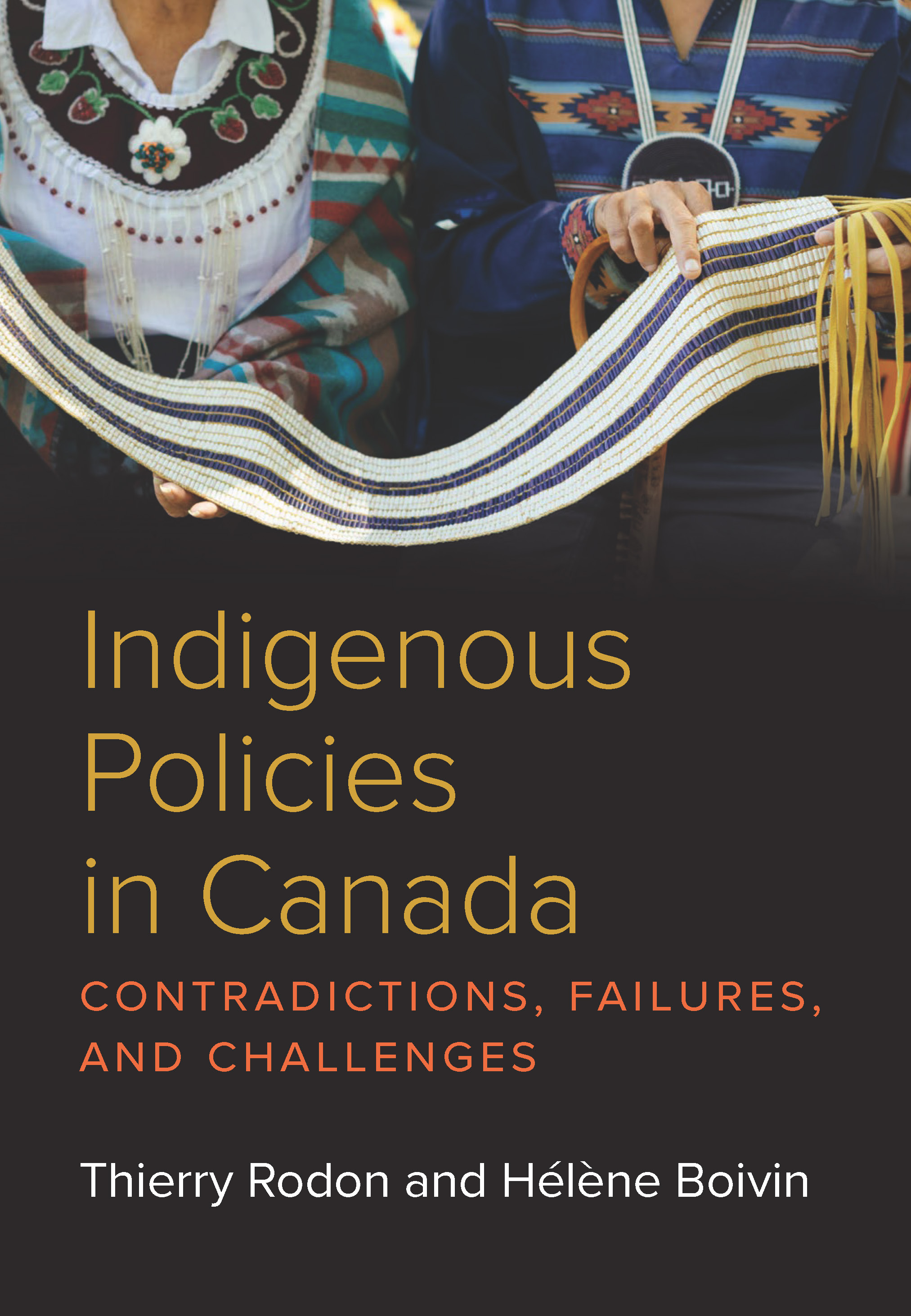
How can a country that prides itself on reconciliation still reproduce colonial inequalities? In this powerful and accessible book, political scientist Thierry Rodon and Innu researcher Hélène Boivin trace more than five centuries of Indigenous–state relations to reveal how Canada’s policies toward First Nations, Inuit, and Métis have evolved—and where they continue to fail.
From the first alliances of New France to today’s struggles over land, self-government, and resource development, the authors uncover the contradictions at the heart of Canadian policy: recognition without true equality, consultation without consent, progress shadowed by persistent injustice. Yet this is also a story of resilience. Across every chapter, Indigenous Peoples emerge not as victims of history, but as political actors who have shaped—and continue to reshape—the country. With clear analysis, supported by data, and comparative perspectives from Australia, New Zealand, and the United States, Indigenous Policies in Canada offers an indispensable guide to understanding how colonialism endures—and how it can be dismantled. Featuring a moving foreword by Senator Michèle Audette, this book invites readers to look beyond reconciliation as rhetoric and imagine a future grounded in respect, recognition, and shared responsibility.
This text is a vital read for students, policymakers, and anyone seeking to understand the real foundations—and the unfinished work—of reconciliation in Canada.
Features:
Foreword written by Michèle Audette, Senator and Innu from Uashat mak Mani-Utenam
Critical examinations of Indigenous–state relations, self-determination, and governance in Canada and beyond
Includes pedagogical features such as learning objectives, end-of-chapter summaries and key points, and an end-of-text glossary
List of Sidebars, Figures, Tables, and Abbreviations
Foreword
Michèle Audette
Acknowledgement
Introduction
Chapter 1: Indigenous Peoples in Canada
PART I: A LONG AND COMPLEX RELATIONSHIP
Chapter 2: The Evolution of Indigenous Policies: From Alliances to Colonization
Chapter 3: The Quest for a New Relationship: Impasses and Failures
Chapter 4: Aboriginal Law: Recognizing the Rights of Indigenous Peoples while Upholding Canada’s Sovereignty
Chapter 5: Indigenous Peoples, the Federal Government, and the Provinces
PART II: CHALLENGING THE COLONIAL ORDER
Chapter 6: Indigenous Resistance and Power
Chapter 7: Indigenous Women and Canada’s Indigenous Policies
PART III: CANADA’S INDIGENOUS POLICIES
Chapter 8: Canadian Land Claims Policies
Chapter 9: Many Paths, One Objective: Indigenous Self-Government in Canada
Chapter 10: The Long and Winding Road Towards Inuit Self-Government
Chapter 11: Tradition and Transformation in Indigenous Economies
PART IV: OTHER INDIGENOUS POLICIES
Chapter 12: Quebec and the Indigenous Peoples: A Clash of Nationalism
Chapter 13: Indigenous Policies in Other Anglo-Saxon Settler States: United States, Australia, and New Zealand
Conclusion
Glossary
References
Rulings Cited
Biography
Thierry Rodon is a full professor in the Department of Political Science at Laval University and Research Chair on Sustainable Development in the North. He is also director of the Interuniversity Center for Indigenous Studies and Research (CIERA), and directs MinErAL, an international research network on the relationship between extractive industries and Indigenous communities. The author of numerous publications on Aboriginal politics, treaties, and self-government in Canada, he studies Aboriginal and northern politics in Canada and in the circumpolar world.
Hélène Boivin is a member of the Pekuakamiulnuatsh First Nation of Mashteuiatsh and has been working for more than thirty years in the defense, assertion, and recognition of the rights of Indigenous Peoples. Trained in social sciences at the University of Quebec at Chicoutimi, she has developed recognized expertise in Indigenous governance, government relations, and territorial negotiations, notably within Pekuakamiulnuatsh Takuhikan. Actively engaged in self-determination processes, she has chaired the Tipelimitishun Commission since 2019, responsible for the development of a constitution specific to her Nation, a central initiative aimed at strengthening political autonomy, protecting the territory, and affirming the identity of the Pekuakamiulnuatsh. Through her conferences, publications, and public speaking, Hélène Boivin contributes to advancing reflections on sovereignty, governance, and the relationships between peoples.
“Anyone interested in understanding the complex history of Indigenous policies in Canada would do well to read this book. It offers a window into laws, policies, and relationships that are foundational to Canada, and how Indigenous people are impacted by these policies, and equally important, how they navigate them.”
—Dr. Gabriel Maracle, Assistant Professor, Department of Political Science, Carleton University
“This book provides a comprehensive overview of Indigenous policies and politics in Canada. The authors highlight how, in spite of the negative and far-reaching impacts of colonialism, Indigenous Peoples have demonstrated their resiliency and determination in the face of the difficult challenges that confront them in the 21st century.”
—Dr. Gary Wilson, Professor and Chair, Department of Political Science, University of Northern British Columbia
“Drawing on an impressive body of literature and perspectives, this book provides a clear, balanced, and nuanced account of Indigenous–state relations in Canada. It is an authoritative and accessible introduction that will be invaluable for students and instructors alike.”
—Dr. Christopher Alcantara, Professor and UWO Faculty Scholar, 2024 –2026, Department of Political Science, The University of Western Ontario
“Indigenous Policies in Canada is a careful and insightful exploration of the sometimes contradictory institutional, legal, and political forces that drive Indigenous policymaking in Canada. The text consistently centres Indigenous agency and resistance, making it a distinct resource in the field of public policy and Canadian politics. Crucial topics like intergovernmental relations, Aboriginal law, and self-government are among the most challenging for undergraduate students to grasp. The text directly meets this challenge through systematic analyses, detailed examples, and a narrative style that accessibly presents complex policy developments. Moreover, a chapter on Indigenous women that highlights their political and policy contributions is especially welcome.”
—Dr. Minh Do, Assistant Professor, Department of Political Science, University of Guelph
“Thierry Rodon and Hélène Boivin provide an excellent and comprehensive overview of Indigenous policies in Canada. Critical and rich in detail, it is a valuable resource for both newcomers to the topic and experts, as well as for students and practitioners. This masterpiece offers nuanced insights into policies at different scales and their complex interconnections.”
— Dr. Gertrude Saxinger, Professor of Applied Integrative Geography, University of Graz, Austria, and Faculty Member, Austrian Polar Research Institute
Reflowable eTextbooks respond to the size of the device they are viewed on, much like a typical website. This causes them to look different from a traditional book. They may also contain embedded audio, video, or interactive components in addition to the VitalSource Reader's standard study tools.
What is a Fixed Layout eBook?
A fixed layout eTextbook maintains the look and the feel of a printed textbook. The text is fixed, and the screen size determines the size of the text. These eTextbooks work best on large-screen devices and do not contain any embedded media or interactive content.
Auto Renew
Auto renew allows e-book rentals to be automatically renewed after the initial rental duration. If enabled, you will automatically be charged and your rental will renew for the same duration as purchased. Auto renew is set to off by default. If auto renew is off, you lose access to the e-book after the rental duration.
Hi there!
All digital products are non-refundable and cannot be downloaded outside of the VitalSource Bookshelf app.
The digital eBook you have selected is a Rental and will expire when the selected duration runs out. If you would like to purchase lifetime access to this eBook, please select a Purchase option instead.