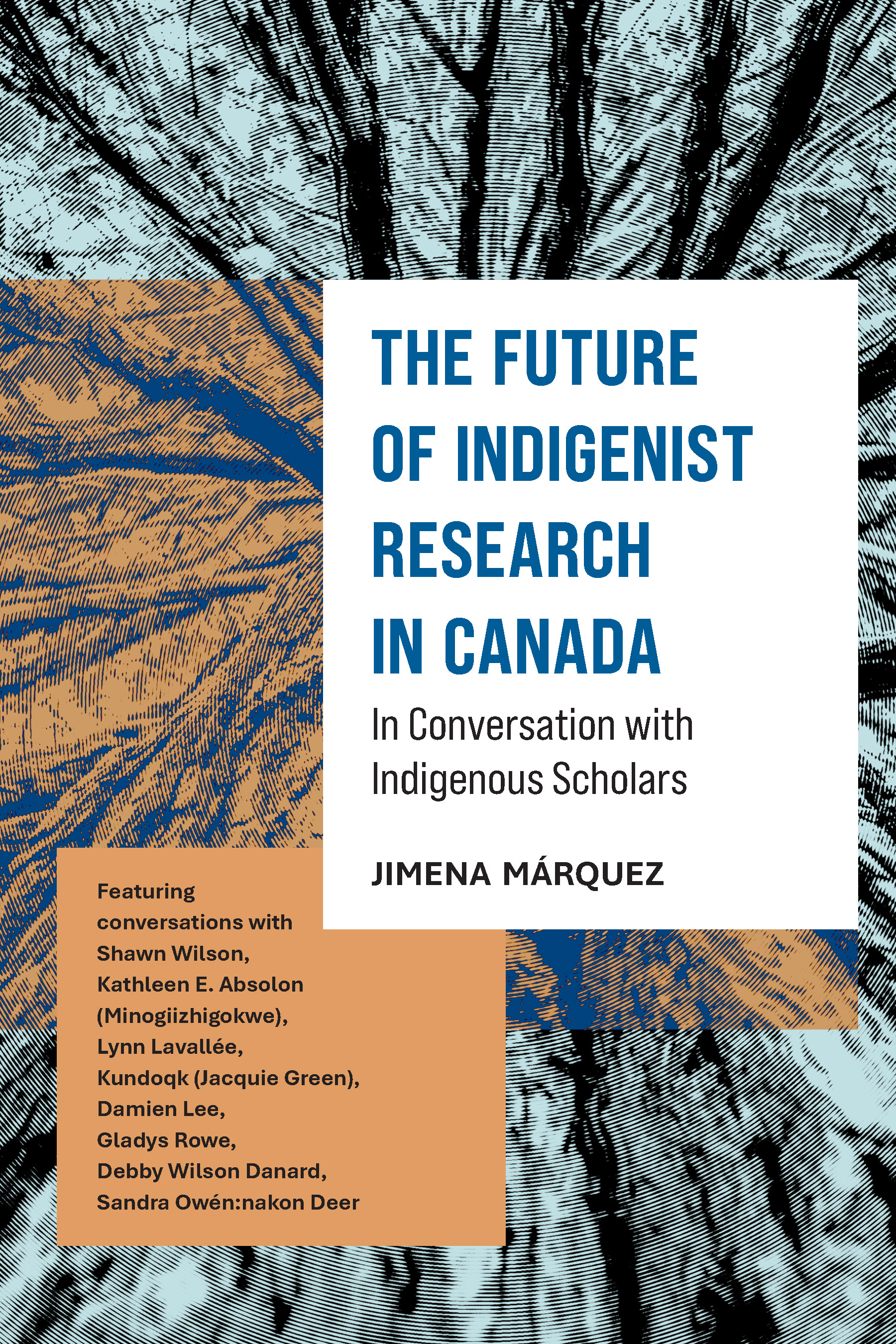
This timely and engaging volume brings together eight remarkable, leading, and emerging Indigenous scholars from various fields in conversation with author Jimena Márquez to critically assess the state of Indigenist research in a post-Truth and Reconciliation Commission era. Through ten thematically organized chapters, Márquez uses a multigenerational dialogical lens to explore what work has been done over the last decade, what shifts are taking place now, what’s in store for the future of the field, and who should take on this valuable work and how they can be held accountable to Indigenous communities.
Topics include the core principles of Indigenist research, intellectual integrity, identity-shifting strategies still present in academia, and the consequences of misguided approaches. Through these candid conversations, students and researchers will get a rare view into the complexities of decolonial scholarship and the responsibilities it entails. Woven together and contextualized by Márquez, the discussions converge on a shared direction forward and offer a tool for critical reflexivity to support readers in decolonizing their own research practices.
Designed to be accessible and thought-provoking, this is an ideal resource for students beginning their journey into Indigenous research methodologies, as well as for student researchers who might already have an Indigenist project in mind.
Features:
The text is structured around candid, in-depth conversations with senior and emerging Indigenous scholars, including Dr. Shawn Wilson, Dr. Kathy E. Absolon, Dr. Lynn Lavallee, Dr. Kundoqk, Dr. Jacquie Green, Dr. Gladys Rowe, Dr. Damien Lee, Dr. Debby Wilson Danard, and Sandra Owén:nakon Deer, whose work is foundational to Indigenous research methodologies worldwide. Their lived experience, critical reflections, and collective vision offer students rare access to the thinking behind the theory
Contains helpful instructor tools such as thoughtful discussion questions for individual and group reflection, further readings curated by field experts, and suggested assignments that include positionality and reflexivity work
A practical resource that helps students move from performative “decolonizing” language to accountable practice that is suitable for a wide range of course levels
Introduction: Why Consider the Future of Indigenist Research?
Chapter 1: Journeys into Indigenist Research
Chapter 2: The Importance of Relationships in Indigenist Research
Chapter 3: Indigenist Methodologies
Chapter 4: When Relationships Are Missing from Indigenist Research
Chapter 5: Discussing Positionality with Indigenous Scholars
Chapter 6: The Hidden Self: Distorted and Appropriated Positionalities
Chapter 7: Protecting Indigenous Knowledge from Distortion
Chapter 8: The Evolution of Indigenist Research within Academic Milieux
Chapter 9: Strategies to Assure the Integrity of Indigenist Research
Chapter 10: In Conversation with Non-Indigenous Scholars
Conclusion
Afterword
Natasha Ita MacDonald
Appendix
Recommended Readings
References
Author and Contributor Biographies
Biography
Jimena Márquez is a multidisciplinary Mexican/Canadian scholar. She has over ten years of teaching experience, most recently in the Indigenous Studies program at McGill University. She received her PhD from the University of Ottawa. Her research focused on Indigenous Canadian scholarship across disciplines, looking specifically at Indigenous Epistemologies and Methodologies and the crucial role that positionality plays in Indigenist research. She is currently the Assistant Director in charge of developing culturally relevant programs for Nunavik at Kativik Ilisarniliriniq, the Inuit school board in charge of Inuit education in Northern Quebec.
“Marquez opens up the conversation about Indigenist research. This work is a change maker for those wanting to do research alongside us.”
—Kahente Horn-Miller, PhD, Kanienkehaka (Mohawk), Associate Professor and Associate Vice-President, Indigenous Teaching, Learning and Research, Carleton University
“Through conversations with senior and emerging Indigenous scholars, Márquez captures the gestalt of our collective ideas in The Future of Indigenist Research in Canada. This book develops and expands the foundational concepts of Indigenist research, while also demonstrating Indigenist methodologies in practice. Conversations like these create space for the emergence of Indigenist knowledge that will help shape our shared future.”
—Shawn Wilson, PhD, Opaskwayak Cree Nation, Professor, Indigenous Studies, University of British Columbia, and author of Research is Ceremony
“The conversations that Márquez has gathered within these pages are akin to sitting down with a cup of tea and a group of brilliant Indigenous scholars. They speak openly about relationships, protocol, land, and what it truly means to be accountable in Indigenist research. Márquez’s treatment of positionality, congruency, and the ongoing question of who can do this work is both unflinching and generative. For non-Indigenous researchers willing to do the necessary preparation that includes the difficult identity work this book demands, Márquez offers not a permission slip, but a wayfinder. This is essential reading for anyone committed to Indigenist research that honours all our relations.”
—Lisa Howell, PhD, Assistant Professor, Indigenous Perspectives and Contemporary Issues in Educational Research, Faculty of Education, University of Ottawa
“The Future of Indigenist Research in Canada is an indispensable how-to for scholars, modeling relational research and providing guidance for those seeking to pursue Indigenist projects. Marquez’s book contributes insightful dialogue between herself and established and emerging Indigenous scholars discussing key questions founded on good relations, dissolving the Indigenous versus non-Indigenous binary—a key step in revitalizing reconciliation and securing Indigenous futurity.”
—Noelani Arista, PhD, Associate Professor, History and Classical Studies, Director, Faculty Arts Institute of Indigenous Research and Knowledges, McGill University, and Canada Research Chair, Tier II in Indigenous Land, Governance and Language
“The future of Indigenist research in Canada lies in centering Indigenous knowledge, decolonizing, and community-led methodologies that de-center colonial frameworks toward creating re-search steeped in relational accountability and reciprocity. This book recognizes that Indigenous leadership in re-search is essential to advancing meaningful reconciliation, fostering innovation, and ensuring that research reflects the priorities and lived realities of Indigenous peoples.”
—Kathy E. Absolon (Minogiizhigokwe), PhD, Anishinaabekwe from Flying Post First Nation, Ontario, Professor, Indigenous Studies, Faculty of Social Work, Wilfrid Laurier University
Instructor Resources
Instructors adopting The Future of Indigenist Research in Canada for their course will receive access to a Data Extraction Table supplement.
Contact your rep to view a supplement sample or request a download code.
Reflowable eTextbooks respond to the size of the device they are viewed on, much like a typical website. This causes them to look different from a traditional book. They may also contain embedded audio, video, or interactive components in addition to the VitalSource Reader's standard study tools.
What is a Fixed Layout eBook?
A fixed layout eTextbook maintains the look and the feel of a printed textbook. The text is fixed, and the screen size determines the size of the text. These eTextbooks work best on large-screen devices and do not contain any embedded media or interactive content.
Auto Renew
Auto renew allows e-book rentals to be automatically renewed after the initial rental duration. If enabled, you will automatically be charged and your rental will renew for the same duration as purchased. Auto renew is set to off by default. If auto renew is off, you lose access to the e-book after the rental duration.
Hi there!
All digital products are non-refundable and cannot be downloaded outside of the VitalSource Bookshelf app.
The digital eBook you have selected is a Rental and will expire when the selected duration runs out. If you would like to purchase lifetime access to this eBook, please select a Purchase option instead.