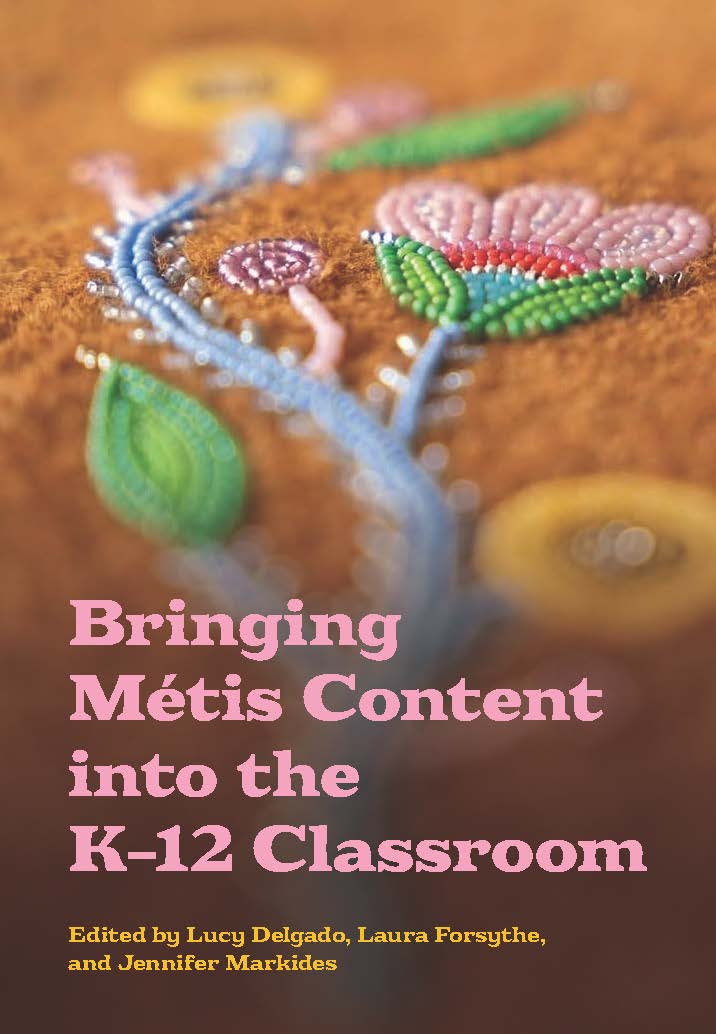
This first-of-its-kind Canadian resource provides educators with the tools, knowledge, and confidence to meaningfully integrate Métis perspectives into classroom teaching for a wide range of grade levels. Developed by authors with lived experience as Métis educators, this volume responds directly to urgent curriculum gaps and the Truth and Reconciliation Commission’s Calls to Action by offering practical, culturally grounded pathways for teaching Métis history, culture, identity, and contemporary realities, in order for educators to create a more inclusive and meaningful classroom experience.
The editors focus specifically on centring Métis knowledge, addressing the long-standing absence of classroom-ready materials. Designed for both novice and experienced educators, the text balances accessible theoretical grounding with highly practical implementation.
The text is organized into three parts to support different teaching styles and experience levels: pre-made lesson plans, stories and articles to inspire lesson planning, and links and recommended readings for supplemental learning. Throughout, educators are supported with editorial scaffolding, adaptable activities, assessment tools, and reflection questions. Each lesson is designed to be flexible across grade levels, supported by a custom index that allows users to quickly locate content by age group, theme, or curriculum focus.
Bringing Métis Content into the K–12 Classroom positions educators as fellow learners alongside their students and offers a respectful, practical, and accessible entry point into Métis education.
Features
Accessible for non-Indigenous and novice educators without compromising depth or integrity, written by Métis authors with lived experience, ensuring authenticity, accuracy, and cultural respect
A practical and adaptable resource that supports educators in integrating Métis perspectives into classrooms through ready-to-use lesson plans, stories, activities, suggested assignments, and additional curated resources
A custom index helps readers locate content by age group or topic for fast, practical navigation
Foreword: Realizing Self-Determination Through Métis Education: Creating a Sense of Classroom Belonging for Métis Students and Their Families
Yvonne Poitras Pratt
Introduction
Lucy Delgado, Laura Forsythe, and Jennifer Markides
Part I: Lesson Plans
Section A: Land
Lesson Plan 1: Exploring Métis Relationships with Land Through the Seasons
Nicki Ferland and Meghan Young
Lesson Plan 2: Visiting with the Land
Rupertsland Institute and Holly Brandsma
Section B: Important Métis People, Places, and Events
Plan de leçon 3 : Se (re)connecter grâce au perlage : les enseignements de Cécile
Eva Lemaire et Riplea Lothian
Lesson Plan 4: Nan McKay: Finding Strength
Lauren Jerke
Lesson Plan 5: Métis Soldiers and the Battle of Hong Kong
Connie Wyatt Anderson
Lesson Plan 6: Rooster Town Remembrance Walk
Marika Schalla
Section C: Governance
Lesson Plan 7: Métis Governance: Past and Present
Jocelyne Vogt
Lesson Plan 8: Comparing and Contrasting the Manitoba Act as a Métis Treaty
Connie Wyatt Anderson
Lesson Plan 9: Examples of Fur Trade Networks and Métis Movement Patterns
Joel Gamache
Lesson Plan 10: Charting the Hearth: Home Spaces and Material Culture of the Métis Nation Through Cultural Geography and the Case Study Method
Erin Gurr
Section D: Music, Language, and Games
Lesson Plan 11: Cultivating Michif/Métis Knowledge Through Reading Comprehension
Melanie Griffith Brice and Ava MacLean Zwarych
Lesson Plan 12: Rabbit Dance Mini-Unit
Dayna Inkster
Lesson Plan 13: Soundscape Composition: Creating the Music of the Land
Jennifer Engbrecht
Lesson Plan 14: Métis Version of the “Amazing Race”
Jennifer Markides
Lesson Plan 15: Bougie Bannock
Laura Forsythe
Part II: Content Resources
Content Resource 1: Baanak La Galet di Rita Flamand
Michelle Smith
Content Resource 2: Métis Interpreters of the Numbered Treaties
Tristan Miller
Content Resource 3: Métis Families
Michelle Smith and Sarah Boyer
Part III: Supplementary Learning and Next Steps
Métis Resource List
Carly Lawton
Contributor Biographies
Index
Biography
Lucy Delgado (she/they) is a two-spirit Métis woman from Winnipeg and a citizen of the Manitoba Métis Federation, with ancestral ties to St. Andrews and St. Johns, Manitoba. Lucy is the Canada Research Chair in Michif and Two-Spirit/Indigiqueer Education as Wellness and an Associate Professor in the Faculty of Education at the University of Manitoba.Lucy was named to CBC Manitoba’s Top 40 Under 40, and she is actively involved in the Two-Spirit Michif Local of the Manitoba Métis Federation. A longtime community organizer, Lucy has been involved in initiatives such as Red Rising Magazine and Red Rising Education, 13 Fires, and the Mamawi Project and advocates for Two-Spirit/Indigiqueer Métis peoples in a variety of spaces, from academia to the United Nations.
Laura Forsythe (she/they) is a Michif Associate Professor in the Faculty of Education at the University of Winnipeg. With seven co-edited collections and as co-founding editor of Pawaatamihk: Journal of Metis Thinkers and the Canadian Journal of Indigenous Studies, Forsythe has helped lift up Indigenous scholars’ works for over a decade. She is a citizen of the Manitoba Métis Federation, the official democratic and self-governing political representation of the Red River Métis. Her kinship ties include the Huppe, Ward, Berard, Morin, Lavallee, and Cyr lines. Her ancestors worked for the Northwest and Hudson’s Bay Companies, fought in the Victory of Frog Plain, and owned Lot 31, the site of a contemporary Métis space called Pakan Town.
Jennifer Markides (she/her) is a member of the Métis Nation of Alberta and a Canada Research Chair and Associate Professor in Curriculum and Learning with the Werklund School of Education and the Faculty of Social Work at the University of Calgary. She received the 2021 Dissertation Award from the Canadian Association of Curriculum Studies for her doctoral study, titled “Wisdom and Well-being Post-Disaster: Stories Told by Youth,” and was given an Outstanding Indigenous Scholar/Researcher Award in 2021 from the Indigenous Inquiries Circle. Jennifer’s research focuses on the holistic well-being of youth and Indigenous education, towards systemic change and reconciliatory action. She prioritizes community-engaged partnerships, where the research is responsive to the needs, interests, and knowledges of communities. She utilizes Indigenous research methodologies, emancipatory pedagogies, and arts-based approaches in her scholarship.
Reflowable eTextbooks respond to the size of the device they are viewed on, much like a typical website. This causes them to look different from a traditional book. They may also contain embedded audio, video, or interactive components in addition to the VitalSource Reader's standard study tools.
What is a Fixed Layout eBook?
A fixed layout eTextbook maintains the look and the feel of a printed textbook. The text is fixed, and the screen size determines the size of the text. These eTextbooks work best on large-screen devices and do not contain any embedded media or interactive content.
Auto Renew
Auto renew allows e-book rentals to be automatically renewed after the initial rental duration. If enabled, you will automatically be charged and your rental will renew for the same duration as purchased. Auto renew is set to off by default. If auto renew is off, you lose access to the e-book after the rental duration.
Hi there!
All digital products are non-refundable and cannot be downloaded outside of the VitalSource Bookshelf app.
The digital eBook you have selected is a Rental and will expire when the selected duration runs out. If you would like to purchase lifetime access to this eBook, please select a Purchase option instead.